Energy-efficient scheduling
Lexicographic tardiness–energy scheduling in semiconductor assembly and test hybrid flow shops (M.Eng. thesis)
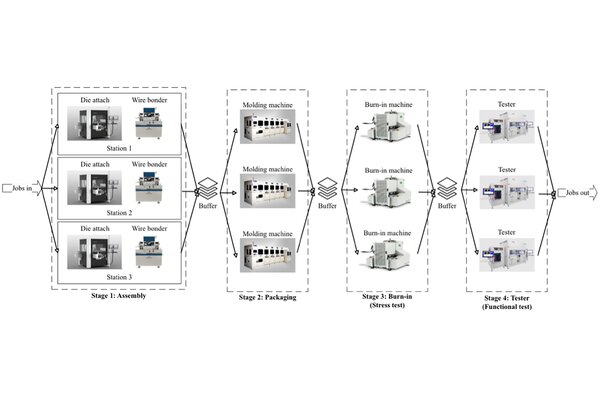
Semiconductor assembly and test facilities run long, energy-intensive operations such as burn-in and electrical testing. Schedulers have to meet customer due dates while consuming as little energy as possible. Delivery performance usually matters more, so I treat the problem lexicographically: first minimize tardiness, then minimize energy without giving any of it back.

What I did
- Formulated a four-stage MILP that integrates job sequencing, machine assignment, burn-in batching and tester speed selection.
- Developed an Extended Teachers’ Teaching-Learning-Based Optimization (E-TTLBO) algorithm with a feasibility-preserving batch-packing decoder.
- Achieved at least 80% lexicographic win rates in 17/18 configurations against a lexicographic GA and 16/18 against simulated annealing, reducing energy consumption by 8.8–21.7% without increasing tardiness.

Collaboration. Part of this work was carried out during my TEEP research internship (Jun–Jul 2026) with Asst. Prof. Nguyen Thi My Hanh at the Global Logistics and Innovative Optimization Lab, Department of Industrial Engineering and Management, Yuan Ze University, Taiwan. A follow-up study extends the model to burn-in batching and multi-site testing and is under review at The International Journal of Advanced Manufacturing Technology.
Code and benchmark instances: github.com/vthquanh/lexicographic-energy-efficient-hfs-scheduling
Publications
2026
- Under reviewEnergy-Efficient Hybrid Flow Shop Scheduling in Semiconductor Back-End Manufacturing with Burn-In Batching and Multi-Site Testing2026Under review at The International Journal of Advanced Manufacturing Technology (submitted October 2026)